Tuesday, April 29, 2014

WILTIMS #143: No phobias? We can fix that.

Today's lectures were rather different from the usual dry science. The first of our two behavioral science lectures was on death and bereavement. Though it was a fairly well done presentation and the short documentary on a young doctor who died of terminal cancer was riveting, my biggest personal takeaway was of how stoic I've already become when dealing with end of life issues.

Whereas several of my classmates were clearly emotionally affected by the stories, my already plentiful experiences around the dying and grieving have given me great practice feeling sincere empathy without becoming distraught.

My first clinical experience over 5 years ago (is that all?) was in an ICU, the unit where it's said patients go to die. Watching a child die and the parents grieve in the PICU was one of the most impactful experiences of my life. Then during treatment for cancer and while subsequently volunteering in an oncology office, I saw another side of death. I watched a friend's personality slip slowly away while their significant other had to grieve far before the funeral. Death can be both tragic and a relief.

I don't look forward to having to deal with patients inevitably dying under my care, but I take solace in the knowledge that I won't be going into that situation blind to the emotional impact.

The other topic of the day was cognitive and behavioral psychology. We spend much of our time discussing old researchers, their theories, and the dubious ways they tested them. The most interesting (and horrifying) was the story of Little Albert. That was the name of a baby boy who was conditioned to have generalized phobias.

Essentially, they showed him a whole slew of animals and objects, none of which he was fearful of initially. They then made a scary noise whenever he was shown a white rat. The kid then became fearful of not just rats but other animals and animal-like masks as well. Needless to say, this experimental setup would never EVER be approved nowadays.

TIL: A lateral cerebellar lesion can cause an intentional tremor. Intentional tremors differ from the non-intentional tremors seen in Parkinson's, because they are associated with the planning and coordination of movements rather than the initiation of said movements.

The habenular nucleus of the epithalamus is located between the pineal gland and posterior commissure.

Monday, April 28, 2014

WILTIMS #142: Hypothalam-THIS!

Eat, drink, be merry, and reproduce. ~The hypothalamus

Well today was brutal. We had a 2½ hour, 100 question exam on behavioral science and then an hour lecture on the hypothalamus in neuroscience. I'm not sure if anyone made it more than 15 minutes into the neuro lecture without their brains turning to jelly.

But all was forgiven when we stowed the notes and ventured into the intrepidly shining spring sun to play some kickball and touch football. A little running around goes a long way towards exorcising the multiple-choice demons.

TIL: In the hypothalamus of the brain, the tuber cinereum becomes the median eminence which becomes the infundibulum. That's three named regions for a stalk less than a centimeter in size. Yay neuroanatomy!


Friday, April 25, 2014

WILTIMS #141: Fern of Life

Quote of the day:
"Any questions?"
[Silence]
"Then I've lost you already..."
[Chuckles]
"Well, it only gets worse."
[Groans]

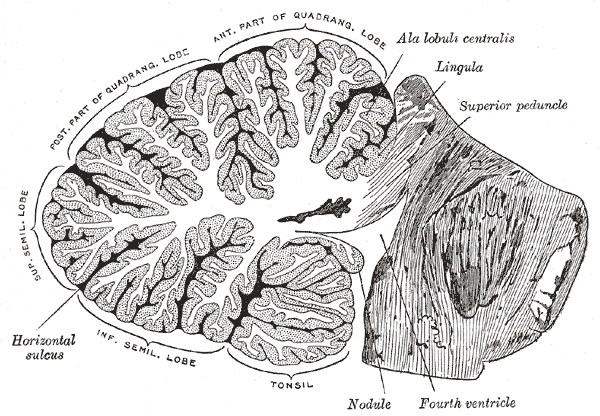
TIL: Whereas the folds of the cerebral cortex are called gyri, folds in the cerebellum are called folia (as in foliage, or leaves). The branching white matter is called the arbor vitae, or tree of life. Amusingly, when checking this out on wikipedia, the critique is brought up that it really looks more like a fern. Apparently either botanists or anatomists are very strict with their metaphors.

The law (and possibly morality?) requires that physicians maintain confidentiality even if someone confesses to murder. Once a deed is done, and you have no proof that they will immediately hurt someone else, you, as a physician, are required not to report the patient to the police, even if there is an open investigation into the crime. The idea is that a doctor's first responsibility is always to his or her patient. However, if they are planning to hurt someone, then all bets are off.

Thursday, April 24, 2014

WILTIMS #140: Happy, happy fun times! /s

Apologies for the rather dreary facts today, but when the topics covered are substance abuse and eating disorders... it's hard to spin into cheery tidbits. Here's hoping tomorrow's more upbeat!

TIL: Anorexic people are often very spiritual. This allows them to be unconcerned with death; it would only mean losing the part of them they don't like.

40% of people have used illicit substances. ⅔ of current users are between the ages of 15 and 23.

Ecstasy (the drug, not the mood) was create in Germany in 1912 as an appetite stimulant.

Though heroin used to be highly associated with the spread of HIV, cocaine has now taken that dubious distinction. The reason is that people have learned not to share needles, which is how both heroin and cocaine users most-easily spread blood-borne infections. The difference now is, with that mode of infection removed, heroin users simply fall asleep during the high while cocaine users are more likely to have unprotected sex.

Tongue in cheek comment from professor: The only difference between benzodiazepine withdrawal and alcohol withdrawal is the smell.

WILTIMS #139: Hi, my name is Christopher and I have no idea what I'm doing...

Today was my first graded mock Objective Structured Clinical Examination (OSCE), and though less than ideally organised, it was actually a lot of fun! Part of the exam entails interviewing standardized patients. These incredibly experienced actors can portray a patient for both a history and physical exam. Today, we only did the history of present illness and a social/sexual history with these actors. We practiced physical exams on each other (presumably because we are too inexperienced to bother a standardized patient with our poorly aimed prodding).

The goal today was just to practice our communication skills in the setting of an actual fake medical exam room with an actual fake patient. It was nerveracking at first but went surprisingly well. The best part was debriefing with the actors not two minutes after they were so convincingly a totally different person. That I managed to comfortably talk to an actor about his fake chlamydia shows how far I've already come in the last year.

Unsurprising fact of the day: Coffee causes and relieves headaches, depending on the dosage.

TIL: Going to Wendy's is totally good for my medical education. Apparently a former student at my school went to the local Wendy's and discovered in the wall display about Dave, the founder of the burger chain, that he had a compensated fourth cranial nerve palsy. And he actually did!

The fourth cranial nerves (or trochlear nerves) control just one muscle in each eye. If one of these nerves fails, the corresponding eye will be rotated in the socket. To correct for this, a person with a fourth nerve palsy will cock their head slightly to level out the bad eye. The good eye can adjust to this angle, but you have to maintain your head in that position in order to avoid blurred vision.

Smoking is a potent comorbidity for brain aneurysms. Smoker aneurysms are more prevalent, they grow faster, they rupture more readily, and they do worse during surgery and recovery.

Projectile vomiting is not simply puke that travels in a parabolic arc. Projectile vomiting is usually caused by increased intracranial pressure and is characterized by being a surprise to both the patient and physician. There is no nausea and no retching - just sudden, explosive vomit.

Pituitary tumors can cause bitemporal hemianopsia (tunnel vision) and diplopia (double vision), by disrupting the second and third cranial nerves, respectively.

Friday, April 11, 2014

WILTIMS #138: Blobs and interblobs

After an excruciating week of twiddling our fingers and faking productivity, we have finally made it to spring break! I'm looking forward to sleep, relaxation, my significant other, and sleep. I probably won't be posting for the next week or so, but I'll be back for the rest of the third block. Now I'm going to get started on that aforementioned sleep...

TIL: Allodynia is a symptom where normally innocuous sensation causes pain.

Anesthesia dolorosa is a really quirky term. It means painful numbness. So... you can't feel it but it hurts? As counterintuitive as it sounds it totally makes sense biologically. Pain and touch are transmitted by parallel but separate nerves from the peripheral body to the brain, so it's possible to pinch off the nerves for touch (causing numbness) while only irritating the nerves that transmit pain.

Blobs and interblobs are apparently actual scientific terms for structures in the visual sensory cortex. I'd tell you more about them but I was not paying attention in lecture and have no desire to research anything right now. When I find out, I will make sure to share that blob-tastic info with you!

WILTIMS #137: Oooo Doc's got game!

Amusingly, just two days ago I thought I had such a busy day that I would share my impressive schedule with you all. Everything, it seems, is relative. So here is a truly busy day:
  • Give cancer awareness club presentation at local middle school
  • Attend captains' meeting for a spring kickball league
  • Sit on lunch panel for interviewees to our med school
  • Don white coat and take part in a small group patient interview at the nearby behavioral health center
    • with a real life patient!
  • Play touch football for half an hour
  • Play ultimate frisbee for two hours
  • Volunteer at the juvenile detention facility
    • which today turned out to be playing basketball
  • Work on neuroscience presentation for tomorrow
The highlight? There are too many to choose. But one of the better moments was at the detention center. I volunteer there nearly every week and we usually play goofy mental games or do arts and crafts. Every once and a while, we spend the hour playing a sport like kickball or basketball in the gym. It's a lot of fun for everyone and the kids often kick our butts.

Knowing that we were playing basketball this week and that the kids are far better than our usual crew of med students, we brought in some ringers. We invited the best basketball players in our class and a good 6-7 of them actually came.

The kids were waiting in the gym for us with their basketball gear on. As the regular from the club stream in, they look very cocky - as they should be. But then the ringers come in. The looks on the kids' faces were priceless. And the last person through the door is a 6'5 tall guy who was a good foot taller than everyone on the home team.

The game was first to 21, win by two and it was a brutal. Fouls went uncalled and boy were there fouls. Med students barely won 22-20. Everyone had so much fun that, for the first time ever, the guards extended the kids' free time so that we could play a second game. The second game was a little less intense which meant we got some of the girls to play. Everyone had a blast, including our players from the med school. Several of them were interested in coming back to play basketball on their own with the kids.

I love that we get to make the kids' day a little more exciting and that they get to see role models as great as my colleagues.

TIL: A Chiari malformation is a defect of the brain whereby the cerebellum and brain stem are squished through the foramen magnum (literally: great hole) at the bottom of the skull. This can cause all sorts of problems including hydrocephalus and syringomyelia (increased cerebral spinal fluid around the brain or in the spinal cord, respectively).