Showing posts with label pathology. Show all posts

Thursday, April 2, 2015

WILTIMS #282-4: Gland Opening!

Spring break starts tomorrow! Woo! Studying will still be going on, but now I get to shift to reviewing old material. Yay? But before they set us loose, we had to get a start on our new block of material, endocrinology, the study of hormones and glands. See you in a week!

TuesdayIL: When looking at pituitary tumors, they become clinically noticeable from either mass effect or excess hormonal production, but rarely both. This makes sense, since if a tumor secretes a hormone, it will cause more and more problems as it grows and will be noticed due to it's systemic effects before it gets noticed for pushing on the neighboring brain regions.

Neuroblastoma and Wilm's tumors look very similar but Wilm's rarely metastasizes to bone, so if you see bone mets, think neuroblastoma.

WednesdayIL: Near the end of a pregnancy, the pituitary gland is hypertrophied and at the limit of its vascular supply (it's bigger and is barely getting enough blood). Though this growth is useful to produce the hormones needed to maintain the gravid state, it puts the pituitary at risk of infarction (stroke). If there is substantial blood loss during delivery, this can exacerbate the problem. If an infarction happens at this point, it's called Sheehan syndrome. Loss of pituitary function can be pretty subtle and, if it's a small infarct, could go unnoticed for years. The main symptoms are lethargy, anorexia, weight loss and an inability to lactate. Since the pituitary controls the thyroid gland, you can also have hypothyroidism, showing water retention, more fatigue, cold intolerance, among many other symptoms.

TIL: TSH level manipulation with thyroid cancer is complicated. Normally, you want to suppress thyroid stimulating hormone (TSH) in thyroid cancer treatment for the fairly obvious reason that part of the thyroid is already growing out of control (hence the cancer), so stimulating it would be counterproductive. Simple, right? Here's the problem: one of the treatments for thyroid cancer is using I-131, a radioactive isotope of iodine, to kill off cancerous thyroid cells. This is a great targeted form of chemotherapy since the thyroid is the only part of the body that takes up iodine in any significant amount. But in order for the thyroid to do this function, it needs to be stimulated by TSH. So, if this treatment is used you must closely regulate the TSH level so that it's high when you want iodine to be absorbed, but low the rest of the time to deter unwanted growth.

With hyperthyroidism caused by subacute thyroiditis, the thyroid does not actually produce any not hormone than usual. Instead, the inflamed state allows more of the preformed stored hormone to leak out of the thyroid follicles than normal.

My favorite disease of the week is the so-called hamburger thyrotoxicosis, which is community-wide outbreaks of hyperthyroidism caused by the accidental addition of bovine thyroid gland into hamburger meat. Thyroid hormones are very potent and if thyroid tissue gets mixed into a large batch of ground beef, it can cause symptoms in hundreds of people. The practice of using the meat near the neck of the cow is strictly prohibited, so this rarely happens and is more commonly seen when a family farm butchers a cow for their own use and doesn't follow the industry guidelines.

Thursday, March 26, 2015

WILTIMS #272-6: Music and a match day

This post is almost a week late, but it's finally here! I will hopefully have another big post for this week in the next couple days. Apologies for my tardiness and, as always, please comment if you have any questions!

Sunday: Over the weekend I went to a classical music concert at another nearby medical school with one of my professors (renowned for his beat-boxed heart sounds) conducting an entire orchestra composed of members of the medical field. Two of my classmates made up half the cello section! It was a really good concert and a nice reminder that not everyone in medicine needs to be a one-dimensional diagnostic robot. Also, we joked that this is one of the few orchestras where it is totally excusable for one of the musicians to need to answer a phone call in the middle of the concert. Several of the doctors in the string section had to answer pages during intermission.

MondayIL: The obturator and psoas signs are diagnostic movements that can be done by the patient to test for appendicitis. These tests work by manipulating muscles in the abdomen to tug on the peritoneum (the sac surrounding most abdominal organs) which is inflamed and will exhibit pain when irritated. These tests look kinda weird though because you stretch and contract these muscles by moving your legs. Yet another example of doctors looking crazy but having a reason. "Your stomach hurts? Well move your right leg for me..."

Ruptured esophageal varices is one of those conditions that is really terrible to treat. These varices (think varicose veins... 'cause that's exactly what they are) are a ballooning of the veins in the lower esophagus due to pressure build up throughout the portal blood system, usually due to liver disease such as alcoholic cirrhosis. The problem is that these veins are prone to rupturing and bleeding into the GI tract. Normally the body would work to clot the blood and stop the bleeding, but since the liver is failing it can't produce the protein clotting factors in the blood. At the same time, the patient is already anemic from blood pooling and lysing in the enlarged spleen thanks to that same portal hypertension that caused the varices to begin with. If you try to give the patient blood, it will just bleed back out again into the GI tract, but if you don't give them blood, they'll die of hypovolemic shock. And your stomach doesn't like blood, so the patient will often be vomiting blood throughout this process and care must be taken that none of it comes back down the wrong pipe or they'll drown in their own blood. Remember the underlying cause of all of this? Alcohol damaging the liver. Please drink responsibly.

TuesdayIL: "Acute abdomen" is a really dumb term that essentially means that surgery needs to be involved, right now. It's just a vague term for any of the numerous conditions that must be quickly ruled out when someone presents to the ER or doctors office with sudden, severe abdominal pain. If one of these conditions is suspected, then it is an emergency and exploratory surgery is often done to both confirm what the specific problem is and hopefully treat it. But since a specific diagnosis isn't necessarily know at that point, we just use acute abdomen as a placeholder.

WednesdayIL: Cholecystitis, an inflamed gall bladder, has a nifty if not entirely PC mnemonic for remembering who is most at risk - the Four Fs: forty fat female and fertile.

ThursdayIL: Alcoholics Anonymous is really religious, but kinda passive-aggressively inclusive at the same time. We had a presentation by a few local leaders of an AA group, where they held an open meeting and shared their stories. And boy were they compelling stories. We were also given a printout of the 12 steps, which I had not read before. I was surprised at how prominently "God" is mentioned throughout the steps, but after hearing one atheist's journey to sobriety and finding a personal definition of God, I was much less concerned about any conflict of sending a non-religious patient to their services.  Though I have seen articles about the lack of any robust evidence that AA is the best treatment for alcoholics, I think I would be supportive of recommending that patients give them a try. I'll take as many tools as I can get.

FridayIL: Match Day is tense and emotional to watch in person. Friday was the day that nearly all the 4th year medical students in the country find out where our algorithmic overlords have contractually sent them for the next 3-5 years. I have in the past watched all sorts of videos of other schools' Match Day proceedings. Many do a big simultaneous opening of the envelopes to add to the drama. There's always a hushed silence as paper is shredded and the soon to be MDs speed read the letter to see if they got their first choice. Then there are screams of happiness, hugs and tears - most of joy, some of disappointment. The rest of the day is a big celebration with everyone running around to see where their friends will be going. The school posts the match list in the hallways and us lowerclassmen creep out of our study holes to ogle the achievements of our fellow students. T minus 2 years until that's me. Yikes!

Friday, December 12, 2014

WILTIMS #230: ♫♪ And now, the end is near... ♪♫

Last WILTIMS post before winter break! Woohoo!
-or-
Last post before first semester finals of dooooooom!!! Woohoo?

Thank you for my first complete calendar year of getting to share the highs, lows, and science of med school with you. I know I've said that I write this partly for myself, but if I never got any views, I'm sure I would have ended this crazy run by now. So, unless I get ambitious and write over break, see you in 2015!

TIL: Kids with congenital heart malformations more often die from a fatal arrhythmia due to the scar from a life saving surgery than from the malformation itself. To be clear, very few of them die from this at all now and most would have died in infancy without surgery. But because we now do such a good job identifying and correcting the surgery, all of these kids outlive their malformation and a few eventually die from a rare long-term  complication from surgery.

Every heart attack patient is greeted in the ER by "MONA":
Morphine - for pain
Oxygen - to combat ischemia
Nitroglycerin - for vasodilation both of peripheral veins and coronary arteries
Aspirin - to prevent clotting and limit inflammation

The reason that heart valves specifically get endocarditis compared to other tissues of the heart is that they are nearly acellular. The white blood cells of the immune system can't get to this tissue to clear the infection. You might reasonably ask how blood cells have a problem getting to valves that are literally bathed in blood. This is where some immunology comes in handy. The way immune cells target and invade infected tissues involves a complex dance along the endothelial cells that line blood vessels. The fibrous tissue of the valves just doesn't have the external markers to slow down and hold on to white cells long enough for them to invade the tissue and do their thing.

Friday, November 7, 2014

WILTIMS #210: ♪♫ Stool-day, bloody stool-day ♪♫♪

TIL: Blood in stool is more complicated than one might think. When my pathology small group leader asked us whether the bloody stool described in a case study was left-sided of right-sided, one of my brighter classmates turned to me and mouthed, "What the f*%#?" I nodded in confusion. How can you tell which side of the colon is bleeding from a description of the bloody stool?

With a little bit of more explanation we both got it. You can tell where in the GI tract the patient is bleeding by how digested, and thus black, the blood is. If it's still red, then it's relatively fresh and likely to be located near the end of the colon or around the anal opening (generally toward the lower left side of the body). If it's black, then it has been digested by its passage through the GI tract. Black blood can originate anywhere upstream, like the stomach or small intestine, but if it is in the colon, then it's on the right side of the body.

Wednesday, October 15, 2014

WILTIMS #198: Tardy as usual...

Apologies once again. I failed miserably at writing a post yesterday. And it was a fantastically eventful day too! But occasionally sleep wins out. I shall make it up to you today/tomorrow. 'Til then, here's a tidbit to tide you over:

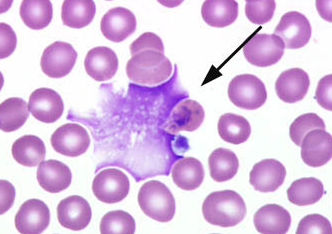
A smudge cell surrounded by healthy RBCs
TIL: One test that is run to diagnose hematopathology disorders (anemias and blood/lymph cancers (leukemias and lymphomas)) is a peripheral blood smear. This one doesn't really need translating. Lab techs literally take blood from a peripheral blood sample and smear it onto a slide. They can then look at the composition of cells and their morphology to try to see if either the comparative amounts of different cells or the shapes of one particular cell type explains a patient's symptoms.

One such morphological indicator is the presence of "smudge cells." This actual scientific term is used to describe diseased B-cell lymphocytes (a kind of white blood cell) that are so fragile that when they are smeared across the slide their cell membrane shreds apart, leaving behind a highly stained blob of DNA from their nuclei. The presence of smudge cells is diagnostic for chronic lymphocytic leukemia (CLL).

Wednesday, September 10, 2014

WILTIMS #181: Stellar

We had our first Foundations of Clinical Medicine (or "How to Be a Doctor") class of the year today. And in the long tradition of wasting time with icebreakers and group building activities, we spent an hour doing a NASA moon crash landing activity. We learned that creativity and action movie logic do not make for a good survival score, that I know way too much about the moon, and that working in groups can make you weaker than had you worked alone (in direct opposition to the likely point of the exercise).

Some important things for when you crash land on the moon:
  1. The moon has no magnetic field (compases won't help you) 
  2. There is no atmosphere on the moon (no lighting matches)
  3. A stellar map is not a "really good" map, but, in fact, a map of the stars
This evening was our school's  club and activities fair at which I was representing three clubs (Cancer Education Awareness Program, Woodfield Cottage Volunteers, and Ultimate Frisbee Club). We joked that the club leadership on campus is very inbred, with nearly every club officer working in the leadership on one or more other clubs. There was a great turnout from the first-year students and new arrivals from the other masters and doctorate programs on campus, which is good because as tradition dictates, all of these clubs will transition to being their responsibility this spring as the second-years progressively lose themselves to preparations for the Step 1 board exam. Given our crazy schedules and often unmanageable volume of work, it amazes me that so many people can find time to volunteer in the community, explore professional interests, and participate in social activities. Perhaps all that stuff we amassed on our med school apps wasn't just for show!

TIL: Crohn's disease and ulcerative colitis are the two main forms of inflammatory bowel diseases. One of the differences between the two include that Crohn's can be found in patches all along the GI tract (or "rooter to tooter" as our pathology resident put it) while colitis is found in one stretch exclusively in the colon. Crohn's also affects all layers of the GI tissue while colitis only disrupts the innermost mucous layer.

Friday, September 5, 2014

WILTIMS #179: Don't Panic

Today, I sensed a disturbance in the force - like a handful of data points cried out and went tragically uncollected. 10 days ago, I transitioned the research project I worked on over the summer so that the two residents I worked with would take over our biweekly data collection while I was in school. But I had a feeling, a spidey-sense even, that the admittedly very busy residents would forget to collect and restock the data cards we have scattered all over the hospital. Apparently I was the last person to collect anything.I think we need a new plan... 

The fun activity for today was our pharmacology problem solving section. For these we break up into small groups and try to figure out which mystery drugs match the vitals signs recorded under various conditions. You work on the puzzle with your team and hope that your team comes to the same conclusions as the other teams. After, you have to justify your answer in front of the class (while being pimped by the professor, regardless of the correctness or completeness of your answer). "Yes, that is what that drug would do under all reasonable conditions, but what about this unreasonable condition?"

Thank the Flying Spaghetti Monster It's Friday! See y'all next week.

TIL: Freaking out during a heart attack will kill you (faster). Activating your sympathetic system increases the workload on your already ischemic heart muscle, which can cause the muscle to fail more rapidly and be more prone to dangerous arrhythmias. Not sure what you should try to feel other than panic during a heart attack though... a macabre curiosity? A stoic determination to make it to phone/hospital?

Folliculitis = inflamed hair follicles
Furuncle = infected hair follicles (aka a boil)
Carbuncle = a cluster of interconnected furuncles (typically caused by a combination of staph infection and diabetes mellitus)

Hashimoto's thyroiditis causes hyperthyroidism then hypothyroidism. This autoimmune reaction causes inflammation of the thyroid, causing it to release more hormones than normal, then as the self-destructive attack continues, the thyroid is damaged to the point of hypothyroidism.

Monday, August 25, 2014

WILTIMS #171: Trouble in immunologic Eden

TIL: The "original antigenic sin" is a phrase describing a fundamental flaw in the immune system's ability to adapt over time. When the immune system is first exposed to an antigen (bad thingy), it tailors the best possible adaptive response to that threat. The problem is that the threat (be it a bacterium, virus, etc) mutates significantly by the time the person is re-exposed to the same antigen. The immune response, though, doesn't change. It's like you finally learn that Achilles' weakness is his heel and you proceed to keep attacking the heel of every descendant of Achilles that you fight. 

We learned last year that the point of maximal impulse (PMI) is a physical exam finding of the location where you can best feel the beating of the heart through the chest wall. This location is usually at the counterintuitively named apex of the heart along the midclavicular line in the 5th intercostal space. Today we finally learned that the reason we care about this heart measurement is because different pathological processes affect this location differently. Whereas ventricular hypertrophy only changes the magnitude of the PMI, hypervolemic distention of the ventricles will also displace the PMI to the left.

Friday, August 22, 2014

WILTIMS #170: To clot or not to clot...

Ugh. That was fast! Today was our first assessment of the year in the form of an 8AM double-header quiz in pathology and immunology. Could have gone better. But studying yesterday, I realized that pathology is going to be much much better than several of the classes we took last year. It took a year but we're finally learning about disease, which is more readily applicable to patient care. Now maybe I'll be readier for the next quiz... 

TIL: To identify a clotting factors deficiency, you mix the patient's blood with normal blood. Normal blood contains all of the clotting factors so this "mixing study" will normalize the clotting time for the patient's blood. To figure out which precise factor is deficient requires a bit more work. Now, you mix the patient's blood with a samples each lacking one of the factors. Any combination that brought at least some of each clotting factors will also normalize, but when you find a combination where both parts of the mixture are deficient in the same factor, the clotting tune will remain abnormal, thus identifying the deficient clotting factor.

Disseminated intravascular coagulation (DIC) sucks. This is a condition brought about by a whole slew of etiologies and whatever you do to treat it will make it worse. DIC causes a widespread activation of the coagulation cascade, resulting in small blood clots blocking small arteries and capillaries throughout the body. The clot storm is so severe though that it uses up all of the clotting machinery resulting in widespread bleeding elsewhere in the body. If you treat the clotting with anticoagulant meds, the patient will bleed out; if you treat the bleeding with clotting factors they'll thrombose, likely leading to an embolism. Yay! The treatment is to try to fix the underlying condition but between 10 and 50% of patients with DIC will die from the condition.

Tuesday, August 12, 2014

WILTIMS #162: Clicking justified

One of the major changes between first and second year at our school is a shift away from purely lecture guided learning (though there is certainly still plenty of that) and towards self-study. The idea being that our professors guide us through the big points but we learn how to best use our time for filling in the gaps. I sometimes feel like we should get some of our tuition back if we're teaching ourselves, but the general idea is sound. We are entering a profession that is constantly changing and we will need to teach ourselves for decades after we graduate.

An interesting change for me is that everything I wrote about last year on this blog I learned in lecture. The few members of my class that for whatever reason read my blog in the past almost always had heard the same anecdotes that day in class. This year, there will be things I find on my own, based on my own study schedule and resources. I'm sure when we start clerkships next year, the trend will only continue. In other words, I think I just justified the crazy trips I so often take down the Wikipedia rabbit hole.

TIL: Amyloidosis is diagnosed by applying a Congo red dye to a tissue biopsy of the affected organ (often the kidney) and looking for an apple-green birefringence under polarized light. Birefringence is a special property of a material whereby it can split a beam of light depending on its polarization and direction. Using a complicated polarisation technique on a pathology slide, substances with these properties will shine bright green while the rest of the field is black.

WILTIMS #161: Med School Strikes Back

If first year is the study of the normal body, second year is the study of everything that can go wrong and, if possible, how to treat it. We learn all of these topics first generally, and then organ system by organ system, as pathology/pathophysiology, microbiology/immunology, and pharmacology. ALL the -ologies!

It was surprisingly rough getting back into the swing of things today, even though we didn't learn much in the way of material yet. But as I dust of the mental cobwebs, I remember back to last year, and can barely believe how far I've come.

"Walk this way..."
Last week I helped out with the new first-years' orientation week. In between panels and walking lost students to their lockers, my classmates and I all agreed that it was so refreshing to see students before their spirits are broken by that first couple weeks of lecture - back when the biggest problems were deciding between buying or renting a microscope and finding the nearest grocery store. We quickly learned that these worries were easily drowned out by the flood of information we were being fed. And then we realized that that first test was a laugh compared to the second - and anatomy/histology was a cakewalk compared to even early physiology/biochemistry - and the cardio exam was at a whole 'nother level... and so on.

By the time summer rolled around we understood: med school never gets easier, it only changes form and/or gets harder. But every victory reassured us that we would survive the next challenge. Every "pass" on an exam showed that we had improved beyond our own wildest expectations from just a few months before.

So when today we heard that this would be the hardest semester yet (until the next, that is) and that all of this was a prelude to the ever looming USMLE Step 1 board exam at the end of the year, I could confidently shrug it off. Looking at the lost first-years in whose shoes we stood 12 months ago, I can't wait to see where we stand 10 months from now as we transition to clerkships. Bring it.

Today I Learned (TIL):
Stopping oral steroids cold turkey can be deadly due to adrenal insufficiency.

Hypertrophy is the abnormal growth of a tissue by increasing cell size, as compared to hyperplasia which is abnormal growth due to the production of additional cells. The term atrophy covers the opposite of both hypertrophy and hyperplasia. Metaplasia is the change from one cell type to another. When any sort of change leads to negative enough consequences, it can be called a dysplasia. Dysplasias are reversible, whereas carcinomas (cancers) are not.

Caseous necrosis is the type of cell death seen in tuberculosis. It is named for its morphologic similarity to cheese (latin: caseus = cheese).