Showing posts with label muscles. Show all posts

Saturday, September 10, 2016

WILTIMS #502-4: The long-lost neuro conclusion!

The blog is still not dead! To sum up what's been going on: the final few days of neuro got left by the wayside, I was studying to take some big tests, and then the past couple weeks have been some of the busiest of all my time in med school. But I'm on nights right now, and some of the important things I need to work on are too important to work on while sleep deprived. Thankfully, I have still been stockpiling things that I've learned every day I'm in the hospital, so I have plenty to share, if I ever get around to sharing it!

~~~Now, we travel back in time to June and my final third-year clerkship, neurology. ~~~

One of the more subtle skills I've learned (but by no means mastered) during med school is figuring out the meaning of the innumerable acronyms that are used in medicine in general and each sub-specialty in particular. Some, everyone knows (e.g. EKG, IV, PO). Others are only commonly used by a select subset of medical professionals and are gibberish to everyone else (e.g G4P2010 of AMA w/ PMH of ASCUS s/p D+C desiring TOLAC p/w PPROM)*

A Monday several months ago, I started my few days in the neuro rehab unit of the hospital. Right away I was presented with the acronym CO, which I had never seen in this context. Carbon monoxide? Colorado? Unfortunately I didn't ask what this meant until so late that it felt awkward (kind of like asking what someones name is again 10 minutes into a conversation with them). But I did ask... and then promptly forgot again. I still can't figure out what it means. But as I haven't been in the neuro rehab unit in months and may never be there again, it can probably fade away in my memory dump, like of all those OBGYN abbreviations.

MondayIL: Strict bed rest causes a 1-3% loss of muscle mass per day. That adds up really fast, which is why there is such a big emphasis on getting patients up into a chair and then walking as soon as possible.

TuesdayIL: It's important to distinguish between crossed and uncrossed diplopia (double vision). When you ask someone if they are seeing double, odds are they don't know if their eyes are crossed or pointing away from each other; it would look pretty similar from their perspective. But to figure out what the problem is, you have to know which eye is moving normally and which isn't. That can be sorted out by looking at directed eye movements but knowing if the eyes are crossing is a good first step.

WednesdayIL: Occupational therapy was created in World War I to help wounded soldiers "occupy" their time. It has since evolved into a therapeutic discipline to help rehabilitate people to do the activities they need to live and work in society.

*Translates to: A woman of advanced maternal age who has been pregnant 4 times resulting in 2 births, an abortion and the current pregnancy, who has a past medical history of atypical cells of undetermined significance and a dilatation and curettage procedure and desires a trial of labor after having previously had a cesarean section presents with preterm premature rupture of membranes.


Thursday, March 26, 2015

WILTIMS #272-6: Music and a match day

This post is almost a week late, but it's finally here! I will hopefully have another big post for this week in the next couple days. Apologies for my tardiness and, as always, please comment if you have any questions!

Sunday: Over the weekend I went to a classical music concert at another nearby medical school with one of my professors (renowned for his beat-boxed heart sounds) conducting an entire orchestra composed of members of the medical field. Two of my classmates made up half the cello section! It was a really good concert and a nice reminder that not everyone in medicine needs to be a one-dimensional diagnostic robot. Also, we joked that this is one of the few orchestras where it is totally excusable for one of the musicians to need to answer a phone call in the middle of the concert. Several of the doctors in the string section had to answer pages during intermission.

MondayIL: The obturator and psoas signs are diagnostic movements that can be done by the patient to test for appendicitis. These tests work by manipulating muscles in the abdomen to tug on the peritoneum (the sac surrounding most abdominal organs) which is inflamed and will exhibit pain when irritated. These tests look kinda weird though because you stretch and contract these muscles by moving your legs. Yet another example of doctors looking crazy but having a reason. "Your stomach hurts? Well move your right leg for me..."

Ruptured esophageal varices is one of those conditions that is really terrible to treat. These varices (think varicose veins... 'cause that's exactly what they are) are a ballooning of the veins in the lower esophagus due to pressure build up throughout the portal blood system, usually due to liver disease such as alcoholic cirrhosis. The problem is that these veins are prone to rupturing and bleeding into the GI tract. Normally the body would work to clot the blood and stop the bleeding, but since the liver is failing it can't produce the protein clotting factors in the blood. At the same time, the patient is already anemic from blood pooling and lysing in the enlarged spleen thanks to that same portal hypertension that caused the varices to begin with. If you try to give the patient blood, it will just bleed back out again into the GI tract, but if you don't give them blood, they'll die of hypovolemic shock. And your stomach doesn't like blood, so the patient will often be vomiting blood throughout this process and care must be taken that none of it comes back down the wrong pipe or they'll drown in their own blood. Remember the underlying cause of all of this? Alcohol damaging the liver. Please drink responsibly.

TuesdayIL: "Acute abdomen" is a really dumb term that essentially means that surgery needs to be involved, right now. It's just a vague term for any of the numerous conditions that must be quickly ruled out when someone presents to the ER or doctors office with sudden, severe abdominal pain. If one of these conditions is suspected, then it is an emergency and exploratory surgery is often done to both confirm what the specific problem is and hopefully treat it. But since a specific diagnosis isn't necessarily know at that point, we just use acute abdomen as a placeholder.

WednesdayIL: Cholecystitis, an inflamed gall bladder, has a nifty if not entirely PC mnemonic for remembering who is most at risk - the Four Fs: forty fat female and fertile.

ThursdayIL: Alcoholics Anonymous is really religious, but kinda passive-aggressively inclusive at the same time. We had a presentation by a few local leaders of an AA group, where they held an open meeting and shared their stories. And boy were they compelling stories. We were also given a printout of the 12 steps, which I had not read before. I was surprised at how prominently "God" is mentioned throughout the steps, but after hearing one atheist's journey to sobriety and finding a personal definition of God, I was much less concerned about any conflict of sending a non-religious patient to their services.  Though I have seen articles about the lack of any robust evidence that AA is the best treatment for alcoholics, I think I would be supportive of recommending that patients give them a try. I'll take as many tools as I can get.

FridayIL: Match Day is tense and emotional to watch in person. Friday was the day that nearly all the 4th year medical students in the country find out where our algorithmic overlords have contractually sent them for the next 3-5 years. I have in the past watched all sorts of videos of other schools' Match Day proceedings. Many do a big simultaneous opening of the envelopes to add to the drama. There's always a hushed silence as paper is shredded and the soon to be MDs speed read the letter to see if they got their first choice. Then there are screams of happiness, hugs and tears - most of joy, some of disappointment. The rest of the day is a big celebration with everyone running around to see where their friends will be going. The school posts the match list in the hallways and us lowerclassmen creep out of our study holes to ogle the achievements of our fellow students. T minus 2 years until that's me. Yikes!

Thursday, May 1, 2014

WILTIMS #144: Stories to come

It's frustrating because I don't have much to show for the work I did today. I promise that I spent most of my afternoon writing and that at some point I will get to share that text with you, but not today. So I leave you with a couple neuroanatomy curios and hope to have a more post-worthy day tomorrow.

TIL: The anteriormost portion of the connection between the bulk of the brain with the brainstem, itself called the cerebral peduncles, is known as the crus cerebri. This tract contains the motor fibers that connect the motor cortices, which enable conscious awareness and planning of movement, with the spinal cord, that relays those commands, and the cerebellum, that does all the unconscious dirty work of keeping you balanced and coordinated. (all of this is super simplified)

The muscles of the face and head that can be controlled independently on one side receive innervation primarily from contralateral axons (nerves from the opposite side of the head). Such muscles include the tongue and lower facial muscles. Muscles that can only my stimulated bilaterally, such as the larynx, pharynx, palate and upper facial muscles are generally innervated bilaterally (from both sides). These rules are not very well conserved, as evidenced by weird folks (like myself) that can independently wiggle their ears.

Monday, November 18, 2013

WILTIMS #69: Gobble gobble

There is an issue with the text justification right now. I'm working on finding a solution.

Let me... um... "enhance" your Thanksgiving by giving you the exact physiological difference between the dark and white meat in a turkey. There are two basic types of skeletal muscle: slow-twitch and fast-twitch. Slow-twitch are used for slower, more enduring movements, as in the legs of a marathon runner. Fast-twitch (as you may have guessed) are those of the sprinter - fast but fleeting.

The slow-twitch muscles need a constant supply of oxygen in order to continue to contract for hours, so they are loaded with myoglobin, a similar molecule to hemoglobin, that store and transport oxygen. Much as hemoglobin is what gives your blood its red color, myoglobin is what tints muscle red. Slow-twitch is redder and thus browner after cooking. So this Thanksgiving, "Can you pass me some of the slow twitch muscle fibers?"

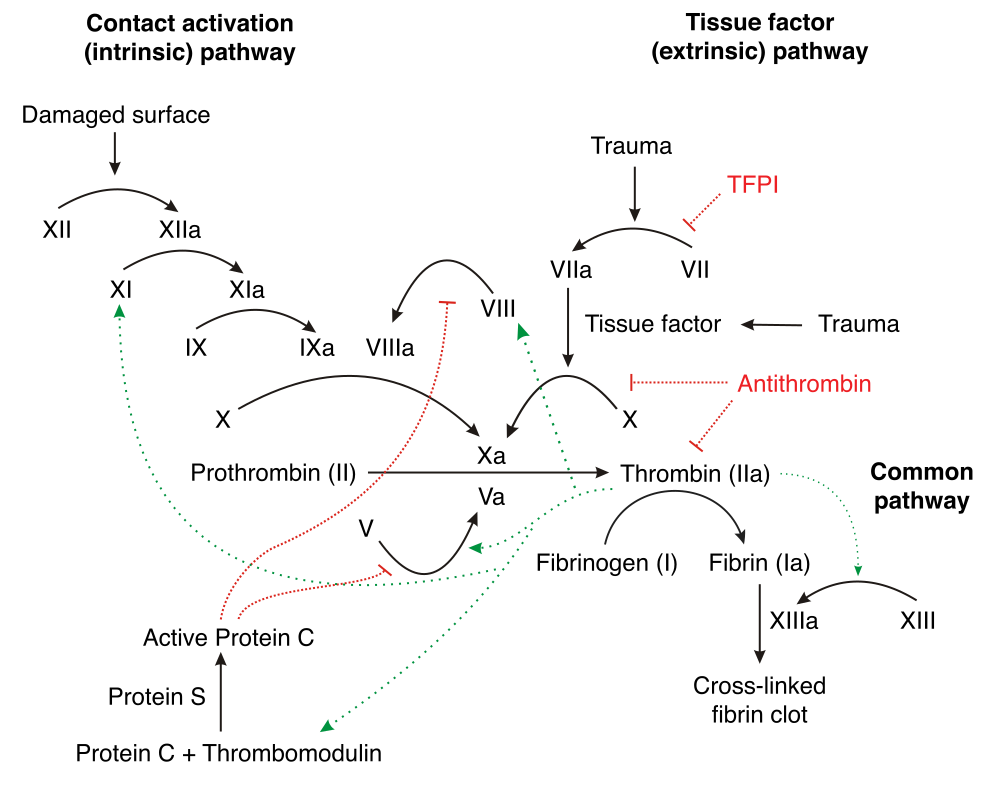
TIL: A prothrombin time (PT) is a lab test used to measure the extrinsic pathway of blood coagulation, a delay in which indicates disruption of factors XII, XI, IX and/or XIII. Partial thromboplastin time, or PTT, measures the intrinsic pathway and defects in coagulation factor VII. If both values are delayed it indicates a defect in factors common to both pathways: factor I (fibrinogen), II (prothrombin), V and X.

Relatedly, today I learned that coagulation factors are named in order of their discovery not their function, which is absolutely useless to all but a biochemistry historian...

Saturday, November 2, 2013

WILTIMS #63: End of Block 1

My official embroidered white coat finally arrived!
It's been a long blur, but the first block of medical school is over! I feel like I've learned so much; yet, it's amazing how much is left to tackle. But the most important thing that I've learned so far is that I really do belong here. It hasn't been easy (and according to the 2nd, 3rd and 4th years it will only get progressively worse), but I'm going to make it through. On to the next course!

TIL: The posterior cricoarytenoid muscles are the sole abductors of the vocal cords. These are the only muscles that open the vocal folds within the trachea, allowing for unimpeded airflow. All of the other intrinsic muscles of the larynx either bring the vocal cords together, allowing them to make sound, or change the length and thickness of the cords to change the pitch.

All but one of these muscles (the cricothyroid muscle) is innervated by the recurrent laryngeal nerve. If you've been following this blog closely from the get go, you may remember the recurrent laryngeal nerve as the branch of the vagus nerve that loops around the arch of the aorta for no apparent reason and then heads back up into the neck. Amazing how long it took for us to connect that nerve with its muscles!

Wednesday, October 23, 2013

WILTIMS #55: BIC pen to the rescue!

Today was a day of battling the urge to nap ...and losing. The heat has been on noticeably high in our primary lecture hall and as a result, you can see so many heads drooping and then jerking awake you might think you watching a metal concert in slow motion.

TIL: Like in the digestive system, the ureter is covered with both a longitudinal and circular layer of smooth muscle. In the ureter, however, the longitudinal layer is the innermost layer covered by a circular layer - the opposite of the layering of the digestive tract.

In the event of a potentially lethal ventricular tachycardia, you can attempt to calm the heart by stimulating the vagus nerve. This can be done by massaging the carotid bulb (the lowest section of the internal carotid artery in the neck). However, you have to be careful not to put too much pressure on the artery or you can risk the patient passing out.

When performing a tracheotomy, you stab between the first cartilaginous rings of the trachea below the thyroid cartilage. Usually the thyroid gland (which looks like a butterfly from the front) is low enough not to be in the way but occasionally it reaches up and blocks your path. What do you do? Cut it in half! The thyroid gland doesn't have a duct; it secrets directly into the bloodstream which it accesses bilaterally. This means you can cut the thyroid right down the middle with no noticeable effect. Push the two halves apart and insert the tracheal tube.

Saturday, October 5, 2013

Study Aid #4

My stab at drawing all the muscles of the back in one diagram (not recommended). Simple, yes?