TIL: The term hysteria originated back in Hippocratic times and comes from the belief that hysteria was an exclusively female disorder caused by the movement of uterus within the body (hence it shares the same root with hysterectomy). This unfounded association lasted for centuries and resulting in some bizarre treatment ideas. An older idea was to put nasty things in the mouth of the patient and flowers or perfumes around the vagina to - I kid you not - try to lure the uterus back into position when it had wandered elsewhere in the torso. More recently, hysteria was treated by orgasm. As documented in the 2011 film Hysteria, the first vibrator was invented to treat women with this disorder.
The term hysteria is no longer used clinically in medicine, having been replaced by the broad category of somatization disorders or, more acutely, conversion disorder.
So remember, if you call a joke hysterical, you're really saying it's... womb-y.
TIL: Apparently part of Pixar's Ratatouille is more lifelike than I had originally believed. Supposedly rat colonies actually have "taster rats" that have extra-sensitive taste receptors to detect poison. If the taster rat hesitates or gets sick, the rest of the colony will avoid the food stash. I love this anecdote and it did come from an expert on taste, but I can't find any reputable source on the internet, so take it with a grain of salt.See what I did there?
When you eat something spicy, you tear-up in an effort to dilute the food in your stomach. As you may remember from Anatomy, tears are produced in glands in the upper outside corner of each eye and drain in a canal by the nose into the nasal cavity. If you sniff rather than blow your nose, the tears will flow back down your throat into your stomach. Along with increased salivation and mucous secretion this dilutes the spicy food, lessening any damage to the rest of the digestive tract.
Babies can taste what the mother eats in her milk and have been shown to prefer those foods later in life. But babies also have more taste receptors than adults, so it is nice to scale down the extreme tastes or the baby may have trouble breastfeeding. Perhaps when nursing, go for a spiciness of 2 for your Thai curry instead of the sinus-clearing 4.
How to eat chocolate (I learned it in a med school lecture, so it's legit):
Make sure it's dark.
Make sure it is brittle.
Appreciate the smell.
Enjoy the feel in your mouth
Enjoy the tastes and flavor.
Taste and flavor are not the same thing. A taste is one of the five qualities discerned through our sense of gustation (...taste). Flavor is the complex integration of taste, smell and memory that your brain associates with the ingestion of a food or drink.
A middle ear infection can cause a temporary loss of taste because some of the taste information from the tongue shares a cranial nerve with the middle ear en route to the brain.
Sorry, but there wasn't much in the way of variety or terribly interesting information today. That being said, it is funny that looking back on the day, I disregarded each scheduled event in turn: boring class on US health care history, overwhelming class on psychiatric medications, and neuroanatomy lab playing around with human brains. That the last one has become tediously commonplace is pretty remarkable. I was poking a brain today and it was no big deal.
I promise not to become totally jaded, but as I naturally become desensitized, it takes a little more effort to see the craziness of the crazy things we do on a daily basis. Feel free to remind me to geek out on occasion.
TIL: Imipramine, a tricyclic antidepressant, is also indicated for use as a treatment for bed-wetting (or nocturnal enuresis if you want to sound fancy).
Doing a lecture on cognitive tests in front of medicals students is rather amusing. Everyone is trying to prove how smart they are. We know. You're smart. We all are. We're in med school. That didn't stop everyone (embarrassingly, myself included) from trying to repeat back 9 random digits or reorder a collection of letters and numbers. I guess it should comfort you that your future doctors are in fact above average at simple memory tests.
Quote of the Day: "If you can transplant it, it's probably not that important. " ~Neurosurgeon
TIL: The penumbra is the area around an ischemic stroke that has lost blood flow and become hypoxic but hasn't died. If the stroke is treated quickly, this tissue can still be saved. If you happen to be an astronomy buff, you will recognize the word penumbra from eclipses. For example, the umbra (shadow in Latin) is the area where the moon casts its shadow on the earth during a full lunar eclipse, completely blocking out the sun. The penumbra is the area where the moon is only blocking part of the sun, or a partial eclipse. Penumbra in neurology comes from the same root because it shows up as a "shadow" on x-ray film.
A useful way of remembering what shows up as white on a head CT (at least in urban areas): bone, blood, and bullets.
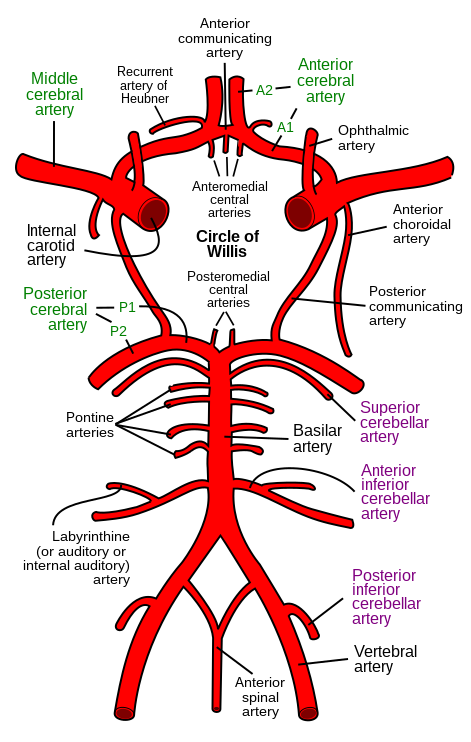
The Circle of Willis is a ring of anastamoses in the brain consisting of the anterior cerebral arteries, anterior communicating artery, internal carotid arteries, posterior cerebral arteries, posterior communicating arteries, but usually not (depending on the source) the basilar artery and middle cerebral arteries. It's all rather confusing because the loop of communicating arteries is fed by other arteries that you may or may not consider part of the circle itself.
As you may have seen on the internet or news, today was Match Day for fourth year medical students around the country. The Match is the almost dystopian system used to pair graduating medical students with hospitals for residency programs. The whole process is completed by a computer algorithm that finds the best fit between the 35,000 applicants and 30,000 positions based off of ranked lists submitted by both students and hospitals. If you read those numbers correctly, you'll note that not everyone matches, though 94% of US allopathic seniors do (international and osteopathic schools generally don't fare as well).
A week before Match Day, emails go out to all applicants telling them whether they matched and, if they did, not saying where. Then on Match Day, all the matched seniors across the country meet at their schools and, at the stroke of noon eastern time, simultaneously open envelopes that tell them where they will spend the next 3-7 years of their lives.
Here are a couple videos showing the typical level of excitement:
My first-year class had lecture from 9-noon, so we got out of class right after the fourth-years had opened their letters. It was really exciting. Everyone was hugging and laughing and sharing tears of joy. They don't graduate or become doctors for another few months but Match Day is the real finale of medical school - the culmination of 3½ years of hard work (not to mention the years before that working to just get in!).
3 more years!
TIL: The first hospitals were developed as a place to treat travelers or pilgrims who couldn't be treated at home. Hospital, hostel, and hotel as share the same root.
Medical school admissions interviews and photos were first implemented at the University of Michigan to screen out Jewish and black applicants who were not otherwise identifiable by name.
Myelomeningocele, also known as spina bifida overta (or just spina bifida to the general public), causes hydrocephalus in 80% of babies. Spina bifida is a condition where a portion of the lower spinal cord doesn't form correctly and leaks cerebral spinal fluid (CSF) into the open air. This is incredibly dangerous because if, left untreated, the child will develop fatal meningitis within days. But once the hole is surgically sealed, the CSF starts building up in the brain because the normal draining routes never formed. Excess CSF fluid is called hydrocephalus and it requires the surgical implantation of a shunt that connects the CSF cisterns of the brain to the peritoneal cavity of the abdomen, where the fluid is easily absorbed.
Type I Chiari malformation is when the cerebellar tonsils block the foramen magnum (the hole in the skull through with the spinal cord passes), blocking CSF circulation and pinching the brain stem.
Dandy-Walker syndrome results from a malformation cerebellum and enlargement of the fourth ventricle.
Alobar holoprosencephaly is an often fatal deformation of the brain where the two hemispheres never develop.
Today I had my first behavioral science case conference and it was one of the most captivating experiences I have had yet in med school. A quarter of our class (about 50 students) decked out in our white coats filed into a small room in the behavioral health center at the nearby hospital and watched our professor interview an actual psychiatric patient. I won't share any specifics due to patient confidentiality but I think we were all surprised by the level of delusion we witnessed today.
Some thoughts from that session:
When interviewing a possibly psychotic patient you must always remain calm and understanding. The patient will be watching to see if you can handle the story they're telling before they are willing to reveal everything.
When appropriate, only challenge the delusion once - just to see how solid it is. Then back off and regain the patient's trust. Challenge in this case means merely asking if the patient has ever doubted that the delusion is real - not yelling at them or anything truly confrontational.
You must be careful about your emotions when dealing with medication non-compliance. Whereas it might be frustrating with other more physical medical problems, remember that non-compliance is actually part of the illness with psychiatric disorders.
TIL:Deer Hunter is a messed up movie. I'm pretty sure our professor wanted to teach us about PTSD by giving us PTSD using the most disturbing parts of this movie.
If a person with depression has one manic episode ever, then they are diagnosed as having a bipolar disorder.
Generally, bipolar patients who are undergoing treatment maintain the same level of symptoms throughout their lives while schizophrenic patients progressively decline.
1 in 7 people with untreated depression and 1 in 5 with untreated bipolar disorder will die from suicide. There is an emphasis on untreated here, but these numbers are still frighteningly high.
Medical students are often equipped with two tuning forks. One tests hearing at a certain frequency and the other tests the sensation of vibration on the skin. This latter might seem a bit unusual; wouldn't a prod with a finger do just as well for testing the sense of touch? You need to test both, actually. "Crude" touch and vibrational touch are relayed to the brain via two different paths in the spinal cord, the spinothalamic tract and dorsal column respectively. A deficit in either is an important diagnostic sign of damage to the nervous system.
Example drawings from a patient with
contralateral neglect syndrome
TIL: The evolutionary age of the brain can be determined by the number of cell layers. Theneocortex is the most recent to evolve with six layers. The archicortex of the hippocampus has only four layers and thepaleocortex only three. Accordingly, the neocortex is only found in higher mammals while the archi- and paleocortices are also present in more primitive animals.
If you damage the visual association areas of the brain you can have a deficit whereby you can't recognize the things you see.
If you damage the somesthetic association area you can have a deficit where you literally ignore anything on one side of your vision. It's not that you can't see it or that you don't know what it is, but that you cannot focus your attention on it. This works for body parts too. You might see that your left arm is there but you think it's not your problem, as if it were someone else's arm.