Tuesday, January 14, 2014

WILTIMS #93: Happily hairless

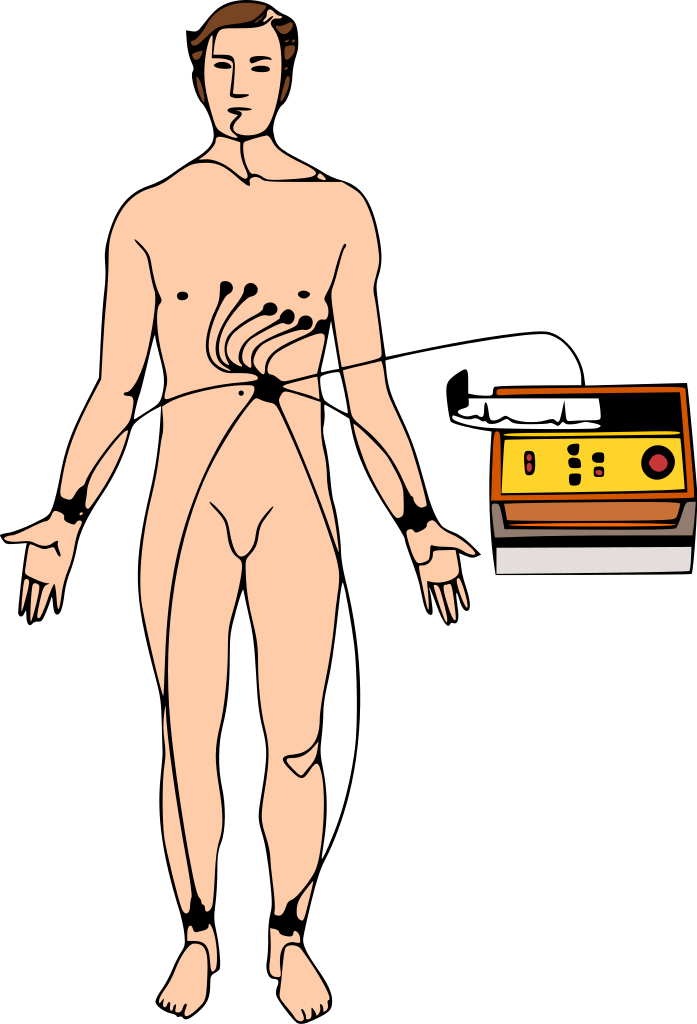
Today we had our blood pressure and EKG lab in physiology. I volunteered to be our first guinea pig and got the below 12-lead EKG for my trouble! Part of what's confusing about these is that you only use 10 physical leads to find the 12 signals - also called leads. Whereas six of the signal "leads" are straightforward and relate directly to physical leads (V1-V6), the other six (I, II, III, aVL, aVR, and aVF) are calculated from the remaining 4 physical leads. Simple! Also note that the genius who came up with this system used the numbers 1-3 and the roman numerals I-III in the same identifying system.

My EKG showed that my heart's mean electrical axis (MEA) is at 88° (a bit right of normal, but not pathological) and that my PR interval is a little long which is not normal, but again not pathological.


TIL: On average, women have less hypertension and subsequently less heart attacks than men until the onset of menopause, at which point the incidence increases to match that of men of the same age. This effect is due to the presence of estrogen (a vasodilator) in younger women. When estrogen levels decrease during menopause, its blood pressure reducing effects decrease as well.

Crucified people don't die from hunger, thirst, or even blood loss; they actually die of low blood pressure. The extended vertical position of the body eventually causes blood to pool in the legs, resulting in postural hypotension (low blood pressure from standing up) and eventually syncope (loss of consciousness) due to cerebral hypoxia (lack of oxygen in the brain).

70% of the circulating blood volume is contained in veins. About 5-10% is in arteries and another 5% in capillaries. Where the remaining 15-20% is? No idea. In the heart itself maybe? I think someone is supposed to tell us this in a couple days... I'll keep you posted!

WILTIMS #92: Side effects include...

TIL: Orlistat, an over the counter weight loss drug, has nasty side effects. The drug works by blocking an enzyme, pancreatic lipase, that normally breaks down triglycerides (which can't be absorbed by the gut) to individual fatty acids (which can). The problems with this are twofold: lipid soluble vitamins can't be absorbed, leading to deficiencies, and the unabsorbed lipids leave the body as fatty stool. Mmmm fatty stool! Diet and exercise are starting to sound more... palatable.

Though the drug acts through a different mechanism, it actually causes some of the same symptoms as cystic fibrosis. CF is caused by a defective cellular chloride transporter resulting in unusually thick bodily secretions. This seemingly small change leads to a number of problems, one of which being decreased or blocked pancreatic secretions, which include pancreatic lipase (the enzyme targeted by Orlistat).

Saturday, January 11, 2014

WILTIMS #91: Eureka!

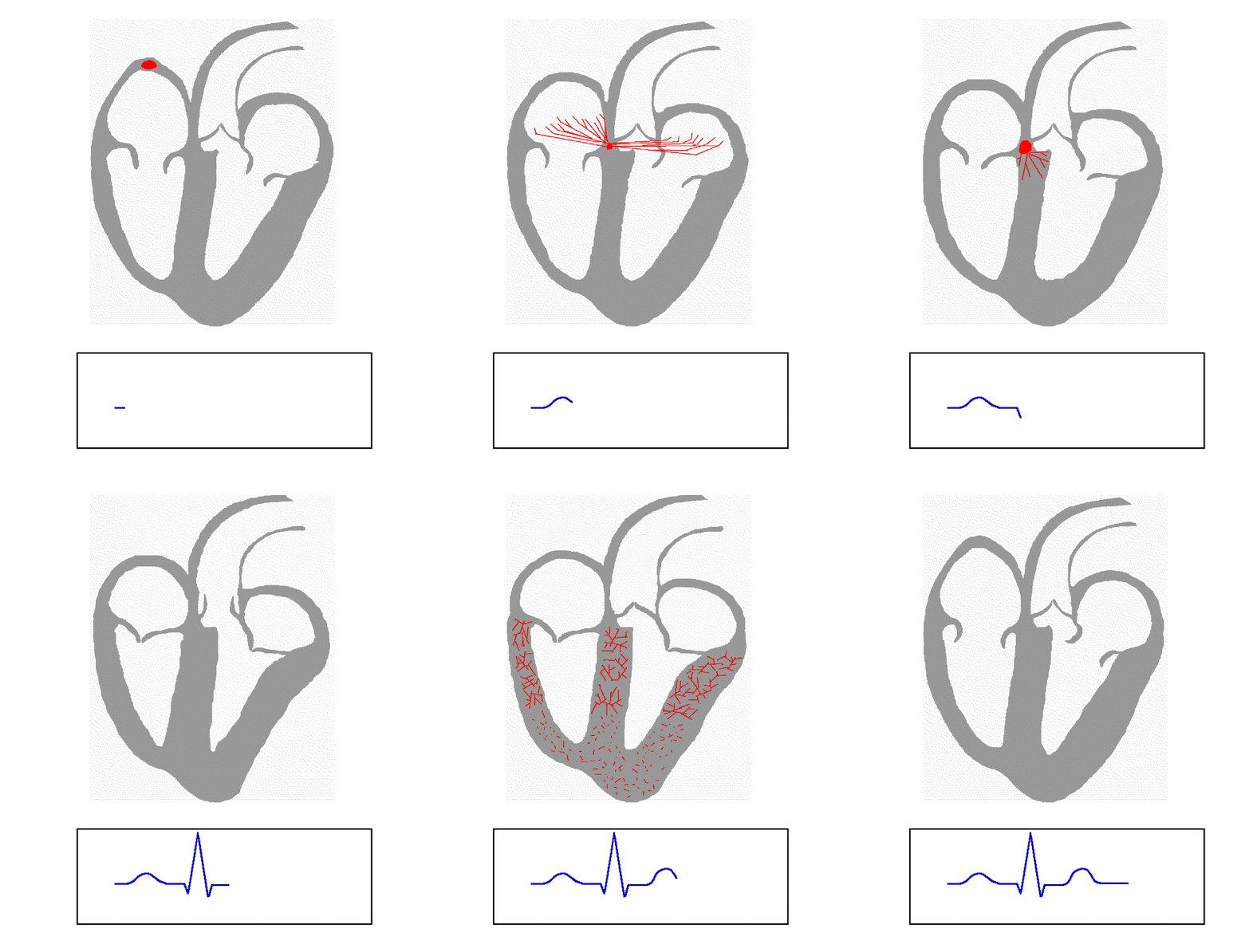
Sometimes I think my consciousness is only a tiny sub-process that my brain employes to keep me occupied while it's working. Case and point: Today, we learned how to read electrocardiograms (EKGs*), which I have been taught at least two other times in my academic career, each time grasping just enough information to survive a test but never really understanding.
Ok, I see how the different waves, segments and intervals line up with the heart's contraction cycle... But why are some waves up and others down? Why do you need a dozen leads when one would seem to do the job?
Today, it just clicked. Made perfect sense. Not sure what I was missing before. I feel like my subconscious was just working away on this one, setting up some EKG-understanding brain pathways while I wasn't paying attention, just in case I should ever come across EKGs again. Well, thank you brain! If you wouldn't mind, could you move on to neurology before the spring block? I know you've also seen those topics a few times before, and hey, it's practically an autobiography for you, so it should be pretty easy.

TIL: Cardiac output is limited by venous pressure. In other words, the heart can only pump so much blood at a time. The maximum amount of blood the heart can pump is determined by a number of factors, like the heart rate, preload, etc. but the limiting factor is the pressure in the veins. Each time the heart pumps, it pulls blood out of the venous system and the veins happily empty, but if the heart is moving too much blood too fast, the veins will collapse. A collapsed vein can't provide any more blood for the heart to pump, so the cardiac output plateaus.

If a spinal cord tumor is located in the lower back just below the tail of the main spinal cord, you don't want to make your incision below the lesion because the cerebral spinal fluid (CSF) will drain and move the tumor caudally (toward the butt) by the change in pressure.  If the tumor is connected to the spinal cord proper, it will dangerously stretch the spinal cord, possibly causing damage.

*The "K" in EKG comes from the original Greek wherein "cardio" is spelled "kardio." Some people use the abbreviation ECG to match the modern spelling, but those people are stupid.

Friday, January 10, 2014

WILTIMS #90: The problem of evil

This evening the campus Oncology Interest Group had as a guest speaker our chancellor, an extremely distinguished and well-spoken pediatric radiation oncologist. I personally think he's just collecting titles ...and winning at it. When answering a rather routine question for this area of medicine, "How do you deal with the unavoidably tragic cases in a field with kids and cancer?," the chancellor waxed philosophic about the "problem of evil." This is the very old conundrum relates to the problem of having evil in the world with an all-good, all-knowing, all-powerful deity.

In medicine and especially oncology, we often (admittedly unfairly) justify some of the things that happen to our patients.
Well, the colon cancer patient had a horrible diet; the lung cancer was undoubtedly due to the 2 packs a day for 40 years; and the guy with the throat cancer drank and smoked!
But pediatric cancers are never the fault of the kid. What's more, the child hasn't lived a long life of fun and debauchery, and may never because of our diagnosis.

So how does one deal with this? The non-religious simply say that it's all random, so I might as well help. The fervently religious may claim that there is some grander plan that for some reason required innocent children to die painfully. But the bulk of physicians, like our chancellor, simply stop thinking so hard about it and help as best they can. Even if there is little we can do clinically, we can improve our patients' and their families' lives by being there for them in these difficult times.

Now for something completely different: I present to you: SuperMouse PEPCK-Cmus! This genetically engineered mouse line was created by up-regulating one enzyme, phosphoenolpyruvate carboxykinase, which is important in gluconeogenesis.

That mouse just ran a 5K race. Crazy.

TIL: Aortic stenosis causes heart sounds to change from "lub-dub" to"lub-shhh-dub".

Excessive fructose ingestion is bad because its metabolism is less regulated in the body compared to glucose. Fructose is quickly used to form fructose 6-phosphate, and it will do this without any negative feedback, consuming all of the body's stores of inorganic phosphate. And that has broad, if vague negative effects on energy metabolism.

Thursday, January 9, 2014

WILTIMS #89: Do as I say, not as I do

Man! When we get a good lecturer, it makes such a difference. After literally falling asleep in physiology, we were kept in rapt attention by our Foundations of Clinical Medicine course ...and FCM is rarely a crowd favorite. We had a talk about providing care to adolescents by a pediatrician who specializes in that prickly demographic. He was hilarious, honest and an absolutely captivating speaker.

One interesting point brought up today was how difficult it is to preach certain professional stances when we are inconsistent about them as a society. For example, recently every pediatric and parenting organisation officially condemned all forms of physical discipline - but the vast majority of us were spanked as kids and don't feel strongly on the issue ourselves. Another one that got some chuckles today was how to tell a teenager that smoking pot is bad when it's legal as of January 1st in Colorado (and again, a good slice of the class has partaken... some quite recently)*.

Hopefully, this same line of reasoning will force me to stay vaguely healthy throughout my life, purely out of fear of my own hypocrisy. No promises though.

TIL: If you're younger than 18, you become an emancipated minor if you are pregnant over the age of 13, a parent, married, enlisted in the armed services, or if appointed by court order (à la Macaulay Culkin of Home Alone fame).

HEADSSS is a dumb though important pneumonic for conducting a psychosocial history:
  • Home - Who do you live with? Where? How is you home life? Any big changes?
  • Education/employment - Are you going to school? How are you doing in school? What grade are you in (compared to age)? What do you what to do in life? Do you work? How much?
  • Activities: What do you do in your free time? Sports? Clubs? Scouts? Anything but solitary gaming etc...?
  • Drugs: Do you know anyone who has experience with drugs? Do you? Smoking? Prescriptions?
  • Sex: Have you ever _____? (Be as explicit as you need to be to ensure understanding) Protection? STDs? Do not assume heterosexuality - always use gender neutral terms.
  • Suicide/depression: How do you feel about yourself? Do you ever feel depressed? (If indicated:) Have you ever thought about killing yourself?
  • Safety, violence, abuse: Do you worry about your safety? Have you ever felt threatened at home? At school?
*Not me! The side-effects of one of my old chemotherapy drugs was permanent lung damage. I have been forbidden from smoking anything ever.

Wednesday, January 8, 2014

WILTIMS #88: Little bunny CO2

My biochemistry professor is an interesting guy. Turns out he worked under Krebs and Fisher - as in the Krebs Cycle, the elegant metabolic pathway that underpins all of aerobic respiration. That Krebs. Unrelatedly, this professor has a bunny funny way of denoting CO2 groups:


TIL: Vitamin B5 (Pantothenic acid) is a component of coenzyme A.

The pyruvate dehydrogenase enzyme complex is a beast of a molecular collection - over 60 total copies of 3-5 different enzymes each with its own prosthetic group. Vitamin B1 (thiamine) is a component of one of these prosthetic groups (thiamine pyrophosphate) and its deficiency, typically only in underdeveloped countries or ye olde sailors, causes the condition known as beri-beri.

If you'd like a good excuse not to exercise, McArdle disease might be for you! The disease is caused by a defective muscle enzyme (glycogen phosphorylase) which normally breaks down the energy storage molecule glycogen into usable energy in the form of glucose 6-phosphate. This energy is what your muscles use at the beginning of exercise. Without this energy, people with McArdle disease experience debilitatingly painful cramps when they start any exercise. The tiny silver lining is that they can actually push through the pain and continue exercising fine thanks to the lipid-based energy that kicks in as a "second wind."

Monday, January 6, 2014

WILTIMS #87: Hello again!


Happy New Year! 2013 was a great year for me (yay med school!), especially compared to 2012 (boo cancer!), so here's to 2014 upping the ante!

We hit the ground running (as usual) today and covered most of hemodynamics (the physics of blood circulation) in Physiology and ALL of glycolysis in Biochemistry. It's still amazing that something that took about a week to teach in undergrad was covered in an hour in medical school - and in greater detail.

Perhaps I'm overreacting though. After all, glycolysis consists of only 10 simple steps!

Glucose is phosphorylated by hexokinase to form glucose 6-phosphate (G6P) via the dephosphorylation of adenosine triphosphate (ATP) to adenosine diphosphate (ADP). G6P is then rearranged into fructose 6-phosphate (F6P) by phosphoglucose isomerase. F6P is irreversibly phosphorylated by phosphofructokinase to form fructose 1,6-bisphosphate (F1,6BP) after the consumption of an additional ATP molecule. F1,6BP is then split by aldolase into dihydroxyacetone phosphate (DHAP) and glyceraldehyde 3-phosphate (GADP). DHAP and GADP are interconverted by triosephosphate isomerase, allowing for complete conversion to GADP, which is exclusively consumed in the next step.
-Halfway there!-
Everything in the second half is doubled thanks to the two molecules of GADP that we derived from glucose. Inorganic phosphate (Pi) is added to GADP by glyceraldehyde phosphate dehydrogenase which simultaneously reduces NAD+ to NADH and produces 1,3-bisphosphoglycerate (1,3BPG). Phosphoglycerate kinase transfers one of 1,3BPG's phosphate groups to ADP, producing ATP and 3-phosphoglycerate (3PG). The remaining phosphate is transferred from the C-3 carbon to C-2 by phosphoglycerate mutase, forming 2-phosphoglycerate (2PG). 2PG is dehydrated to phosphoenolpyruvate (PEP) by enolase. Lastly, pyruvate kinase removes the remaining phosphate, forming another molecule of ATP and our final product, pyruvate.

The net reaction for glycolysis is:
glucose + 2 NAD+ + 2 ADP + 2 Pi → 2 pyruvate + 2 NADH + 2 H+ + 2 ATP + 2 H2O

Appologies for taking this opportunity to study at you!

TIL: The body uses ~200 grams of glucose every day. 80% of this is consumed by the brain and blood cells.

Vasodilator medications reduce the pressure in the arterioles (small arteries) of the circulatory system but also result in increased pressure in capillaries and venules (small veins).